
Project Overview
System: Mitsubishi Electric City Multi Heat Recovery VRF
Application: Commercial building HVAC
Location: Santa Monica, California
Initial complaint: Condensate dripping from supply-air grilles
Final repair: BC Controller temperature sensor replacement
Result: Normal refrigerant control and stable system operation restored
The Situation
A Mitsubishi City Multi heat recovery VRF system was experiencing an unusual cooling-control problem.
The initial complaint was water dripping from supply-air grilles into occupied areas.
At the time of inspection, there was no active condensate leak from the air handler itself. However, supply-air temperature was observed dropping to approximately 28°F, well below normal comfort-cooling conditions.
Frost was also visible on refrigerant piping, indicating abnormally low evaporating conditions.
The system would continue operating for a period and then enter protective shutdown before restarting automatically.
Diagnostic Approach
Live System Monitoring
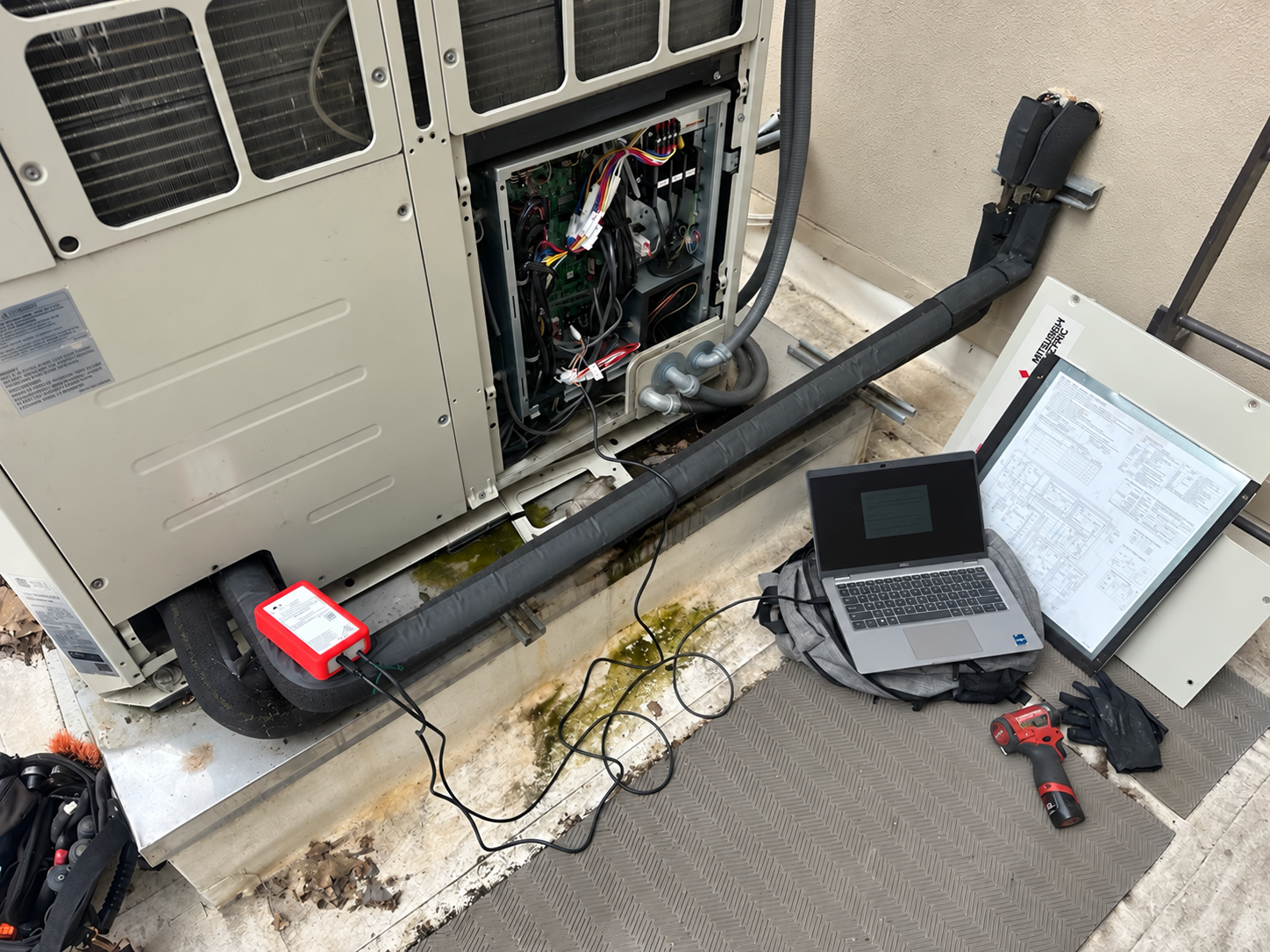
The outdoor unit was connected to Mitsubishi Maintenance Tool for live monitoring and data logging.
Rather than relying only on the visible symptom—condensation at the grilles—the diagnostic process focused on what the refrigerant system and heat-recovery controls were doing immediately before each shutdown.
Live operating data showed abnormal behavior associated with the BC Main Controller.
Approximately 20–30 minutes into operation, multiple BC Controller valves transitioned from partially open positions to heavily restricted positions.
At the same time, suction pressure dropped rapidly and the outdoor unit subsequently entered protective shutdown.
Abnormal Temperature Input
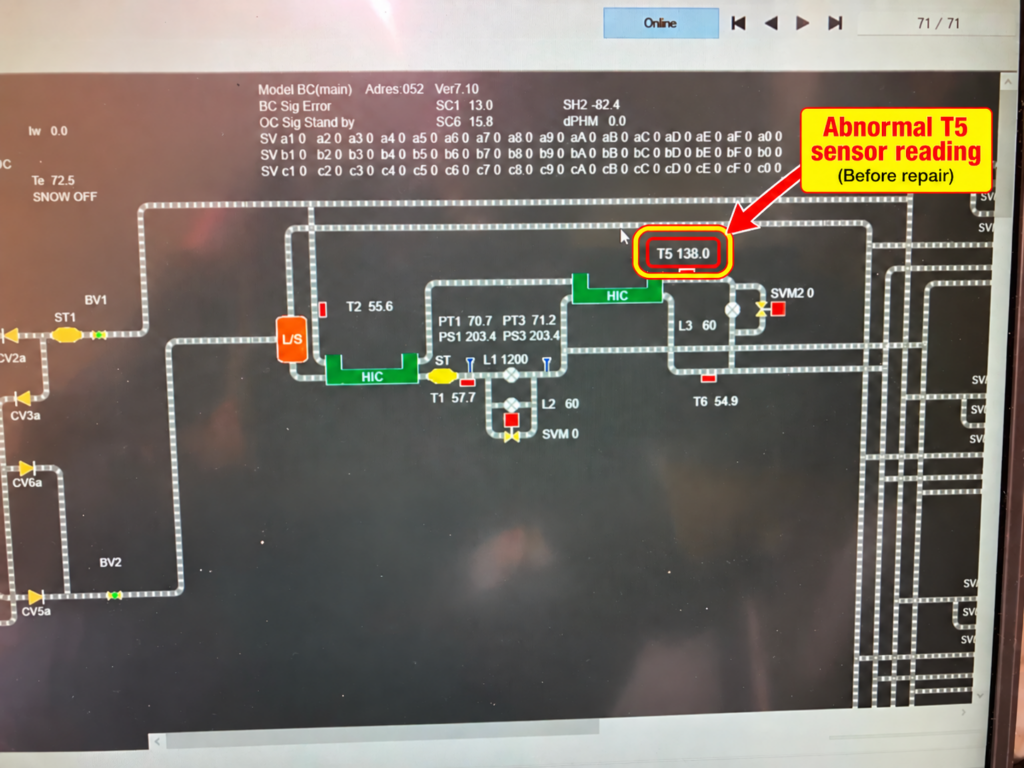
Review of the recorded data identified a significant temperature discrepancy associated with the BC Controller circuit.
The TH5 temperature input was reading substantially differently from corresponding refrigerant-circuit temperatures.
At the first diagnostic visit, possible causes included:
- failed TH5 thermistor;
- poor thermistor pipe contact;
- wiring or connector problem;
- abnormal BC Controller sensor input;
- BC Controller board fault.
Further physical testing was recommended before replacing components.
Follow-Up Diagnosis
During the follow-up visit, the temperature sensor and associated circuit were tested directly.
The investigation confirmed that the abnormal temperature input originated from the sensor itself, rather than from the communication network or controller logic.
This sensor provides temperature feedback used by the BC Controller to regulate refrigerant flow through its electronic valve arrangement during heat-recovery operation.
Because the temperature input was incorrect, the controller was responding to a condition that did not actually exist.
The result was unstable refrigerant control, excessively low evaporating conditions, frost formation and repeated protective shutdowns.
Repair
The failed temperature sensor was replaced.
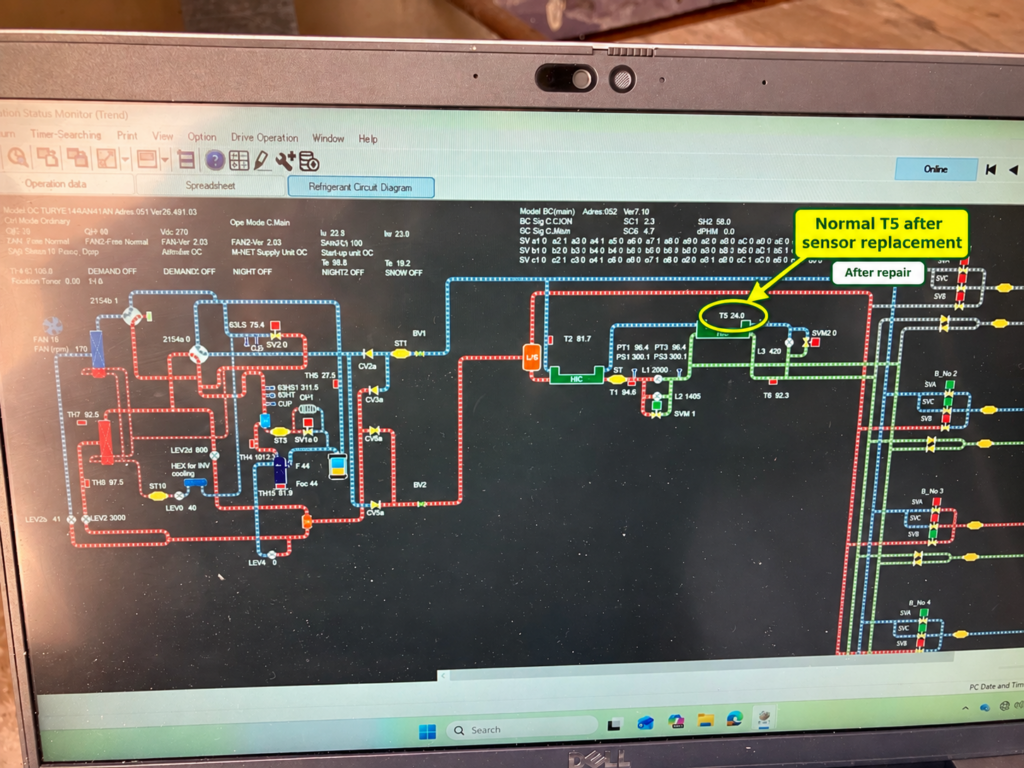
After replacement, the VRF system was restarted and monitored through normal operation.
The BC Controller responded correctly to system conditions, refrigerant control stabilized and the system operated normally without the previous low-temperature behavior or repeated shutdown condition.
Final Result
The repair resolved:
- excessively low supply-air temperature;
- refrigerant piping frost;
- unstable BC Controller valve operation;
- repeated protective shutdowns;
- condensate forming at the supply-air grilles.
The system returned to stable heat-recovery VRF operation.
What This Case Demonstrates
Condensation Was the Symptom, Not the Root Cause
The original complaint appeared to be a condensate or air-distribution problem.
In reality, the water at the grilles was the downstream result of an abnormally cold refrigeration circuit.
Live VRF Data Revealed the Sequence of Failure
Looking only at the equipment after shutdown would not clearly identify the cause.
Logging valve positions, pressures and temperature inputs showed what changed immediately before the system failed.
A Small Sensor Can Affect the Entire Refrigerant-Control Strategy
On heat-recovery VRF equipment, temperature inputs are part of the control logic used to manage refrigerant distribution.
An incorrect sensor value can therefore produce symptoms that appear much larger than the failed component itself.
Diagnose Before Replacing Boards
The abnormal behavior could initially have been interpreted as a BC Controller or control-board problem.
Testing the sensor circuit first identified a much more specific and less invasive repair.
Need Mitsubishi City Multi or VRF Troubleshooting?
Advanced diagnostic service is available for Mitsubishi City Multi, LG Multi V, Daikin VRV and other commercial VRF systems throughout Los Angeles, Ventura County and surrounding Southern California areas.